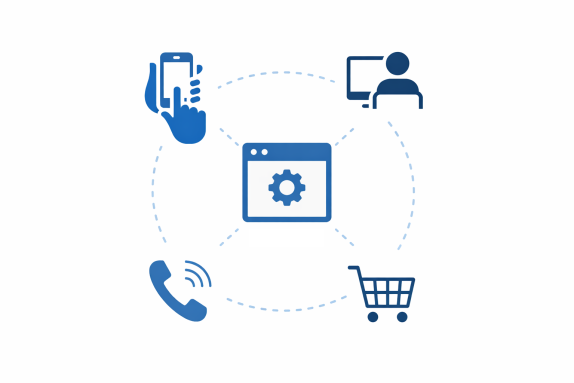
“Your customer must get the same experience in every channel,” says a consultant at yet another marketing conference, citing successful international businesses as examples.
Full of ideas and inspiration, you return to your developer with a brief to transform your e-commerce into a fully omnichannel business. Studies reassure you that it is a smart investment and that the number of customer purchases should double (HBR, SC, …). But once you learn the price tag, the enthusiasm shatters on the floor — will this investment actually pay off? At least that was the situation before the era of AI.
“Omnichannel” always sounds noble: the customer should receive the same experience in every channel. In reality, however, this means integrations, process changes, and many development hours. The same functionality must work across both offline and online systems. A gift card might mean one thing in Magento and something else in the POS system. In the e-shop, the unique identifier for a new account may be an email address, while the POS might use something completely different.
At the same conference, someone quietly remarks from the corner: “But we already do that.” In our experience, smaller or early-stage e-commerce businesses often have their systems better aligned simply because they use the same software for multiple purposes, or because a small and motivated team can smooth over inconsistencies through direct communication.
In this article, we will look at when a full omnichannel approach is justified and when it is smarter to build two or three critical integrations that deliver a unified customer experience with minimal cost. At the end, we outline three different architectural approaches to building an e-commerce ecosystem.
Inventory Availability – The Main Challenge and Opportunity
Following the 80/20 rule, the biggest issue usually relates to product availability — specifically how inventory integrations are handled. Around 70% of online shoppers check stock availability before making a purchase.
Messages like “Discount valid only in the online store” or “Unfortunately, the product you ordered online was just sold in the physical store” have generated many frustrated customer service calls and angry reviews. Most e-shops have solved this somehow, balancing critical stock buffers with customer service efforts.
Another example used by almost every e-shop today is displaying stock availability in physical stores and offering reservation options when order fulfillment happens from those stores. Let’s be honest — many people plan their purchases at the last moment and check the stock of a nearby store before heading out.
Before the era of e-commerce, many of us spent time traveling across the city searching for a specific product or calling multiple stores to check availability.
Products with different delivery times add another layer of complexity. Online, this can be displayed clearly (we covered this in more detail in our article about external assortments), but how should it be handled in retail? When a customer is already standing in the store asking about a product, you would rather not let them leave empty-handed. What software solution should support this?
And there are many more similar examples.
Device-Specific Experiences
Omnichannel aims to provide an equal experience across all purchase points. However, one underused opportunity in e-commerce is to create strategic differences between channels.
If you understand the customer journey — how customers make decisions across devices — you can use that knowledge strategically. For example:
- “Mobile-only price”
- “App-only price”
These offers create exclusivity and encourage customers to complete purchases immediately instead of switching to another device to compare offers.
Omnichannel is not only about devices. When customers cannot find the right product, they often send an email or call the merchant. Sometimes they receive additional information — and occasionally even a better price or a special exception.
Customer service also relies on information systems. But once the customer service agent hangs up the phone, the customer is once again alone and free to do anything next.
Although Estonia ranks among the world leaders in retail space per capita and has a strong e-commerce culture, competition is still far less intense than in markets like Asia. Most customers also tolerate some differences between experiences across devices.
Additionally, the order volumes of most Estonian e-shops are not large enough to justify heavy investment in A/B testing. However, as competition increases and businesses expand internationally, it is worth reviewing your omnichannel checklist with a critical eye.
Customer Data and Campaigns
Data.
We have written extensively about product data and automation. The next — and more complex — step toward omnichannel maturity involves customer data.
First, a merchant must decide where the heart of their customer data will be — the Customer Data Platform (CDP). Large retail organizations typically use a dedicated platform where all customer data flows in and out. In many ways, it functions like a PIM for customer data.
Merchants with smaller development budgets often place this role in a system that already has the most customer interaction, even if it was not designed for this purpose. Sometimes this is simply the most practical solution for the business at that moment.
Typically, customer data is scattered across:
- physical store software
- the e-commerce platform
- spreadsheets
- analytics tools
- email marketing platforms
- and more
The more complex and personalized campaigns you want to create, the more important it becomes to combine these data sources.
Let’s be honest — abandoned cart reminders exist in almost every online store. But more advanced campaigns often remain unrealized due to budget limitations or missing integrations.
Combining data holds enormous potential. Sometimes the opportunity lies not only in combining data but also in combining businesses.
For example, imagine a company that:
- offers accommodation services
- sells products both online and in physical stores
- operates spa services
Each business unit uses different software and maintains its own customer database. The same customer might have purchased through three different systems that are not integrated. Anyone reading this should immediately see the potential business opportunities hidden in such data.
For B2B customers, complexity increases further.
A business client might order from you via:
- automated integrations
- an ordering portal
- a sales manager
- social media
- SMS
- personal email
The smart merchant’s task is to capture these opportunities, bring the customer into their ecosystem, and automate as much as possible. But can the business client see all their orders? Can they see who purchased what and from where?
In B2B scenarios, decision-makers and purchasing workflows add another dimension. Sometimes it is even worth building a dedicated solution for a single large client.
If the system architecture is designed correctly, even a reasonable investment can help you understand customers better and enable true personalization. Sometimes you don’t need a top-tier marketing platform — a clever hack within existing systems may already deliver value.
Omnichannel E-commerce Architecture
A typical mid-sized e-commerce setup often functions as a triangular integration between three main systems:
- ERP / business software
- e-commerce platform
- product information management system (PIM)
Products flow from the PIM to the store, inventory and pricing flow from the ERP to the store, and orders move from the store to the ERP. Additionally, there are usually marketing tools, CRM systems, and analytics platforms involved.
Technically, omnichannel requires well-integrated systems with bidirectional connections, each capable of delivering maximum value.
In practice, however, all these solutions compete for the same client budget. Software vendors constantly expand their feature sets to either:
- lock the client deeper into their ecosystem
- capture a larger share of the client’s budget
A simple Magento module or enabling functionality inside an ERP might deliver significant optimization — but it can also create new development or data challenges.
The key lesson: take time to explore what your existing software can already do and at what cost.
Why? Because there might be easy wins hiding in your current system. The dream of omnichannel often collapses during the integration analysis phase once detailed budgeting begins.
A useful rule of thumb: if something seems obviously logical, clearly increases sales, and does not require major investment — implement it immediately. Don’t wait until the entire system is perfectly structured. You can optimize later.
Three Paths to Omnichannel
Which path should your company take to stay competitive?
Technically, there are three main approaches to building an omnichannel architecture.
1. Invest in integrations
You can use the best capabilities of each system and add innovative solutions. However, development and maintenance costs will continue to grow.
2. Use fewer but multifunctional platforms
You accept compromises in some functional areas, but the systems are already well integrated. Building new features may be slower but the ecosystem remains simpler.
3. Build a custom unified system (CDP)
Create a fully customized platform tailored to your needs, inspired by best practices and designed with future technologies such as AI in mind.
“One road does not lead to success” is one of our favorite sayings, and it applies equally to building a unified customer experience across sales channels.
Most e-commerce merchants already have a system in place that works to some degree (option 1). In these cases, achieving omnichannel goals often means optimizing existing integrations and creating new ones where necessary.
Option 2 works well for businesses serving specific B2B clients where functionality matters more than marketing.
Option 3 becomes relevant for specialized businesses that require deep customer understanding — for example B2B companies, premium consumer brands, or simply merchants who want to build an e-commerce operation that performs exponentially better than competitors.
Which path should you choose?
During 16 years of Lumav, we have participated in hundreds — if not thousands — of discussions about building e-commerce systems. We invest in AI solutions that help merchants achieve their business goals, and one important part of that is improving the consistency of the customer experience.
Come by for a coffee — we’d be happy to share our experience.