Product Information Management (PIM) — all product information in one place, connected to every channel
If your product information is scattered in different channels (part in Excel, part in ERP, part in PIM) and more than one person is responsible for product information — you know the problem. If the product information enrichment processes are not clear enough, a lot of double work and confusion can occur. There is no clear overview where the product information is correct.
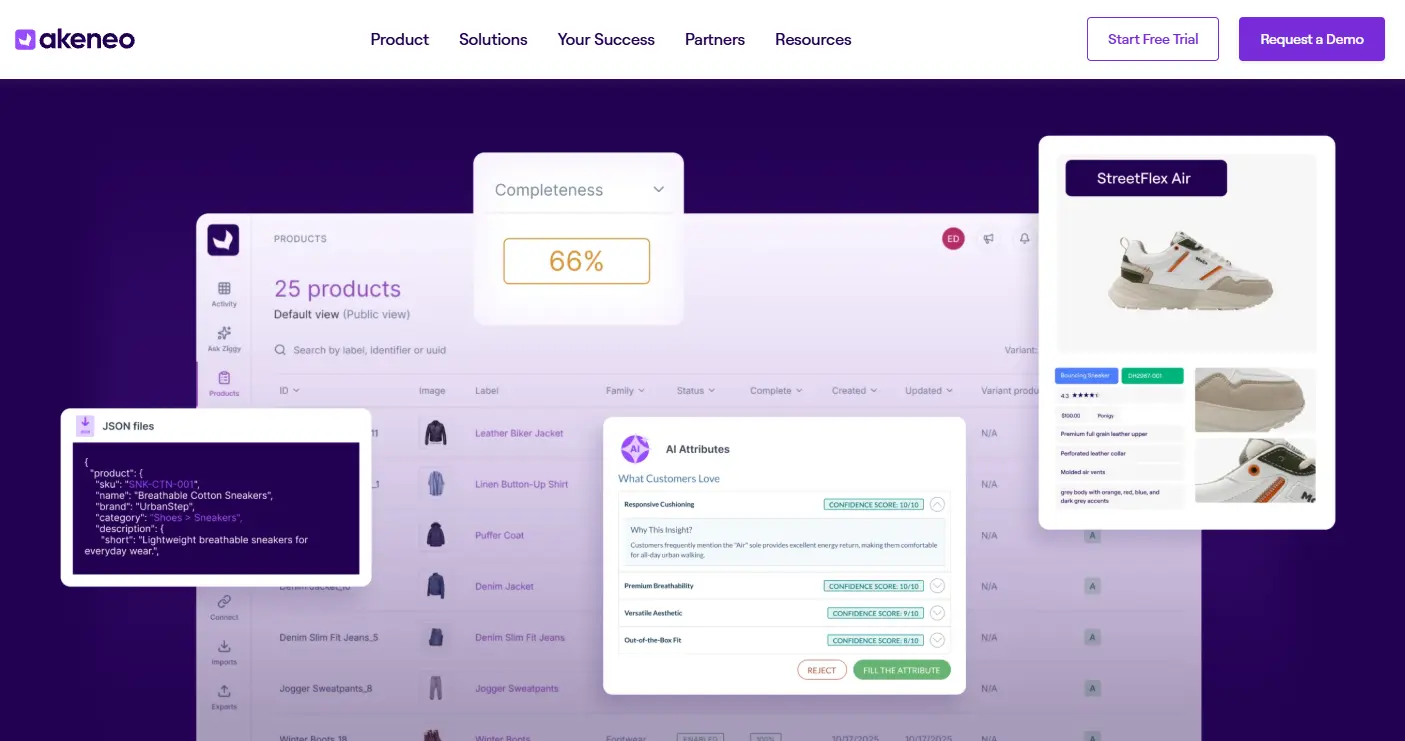
PIM, or product information management system (Product Information Management), gathers all product information in one place and is the heart of your company’s product information, automatically distributing it to all sales channels. Lumav can be a partner only for setting up PIM (Akeneo, custom) or offer a full service with implementation and e-business channels.
The most important thing — the customer cannot order products that are not on the e-store counter. PIM significantly speeds up the product information enrichment process and thus shortens the time it takes to bring new products to market.
My product data is in ERP. Why do you need PIM at all?
Many companies confuse PIM with ERP. Both manage product data, but from different angles. Once you know the difference, you’ll understand why you might need both.
What ERP manages
ERP (Enterprise Resource Planning) is the backbone of your business operations. It manages inventory, pricing, orders, invoices and accounting. ERP knows how much product is in stock and what it costs. But entering and managing product information is inconvenient in ERP, and it is also difficult to give access to external data entrants there.
What PIM manages
PIM manages everything the customer sees and reads about the product: descriptions, translations, images, videos, technical data, certificates, user manuals. Through PIM, you can orchestrate the sending of information to different channels — what goes to the e-shop, what goes to the B2B self-service environment, what goes to the app, what goes to advertising materials.
How do they work together?
The process of creating a new product can start from PIM, ERP, and in some cases (e.g. external assortment) even from the e-store. ERP and PIM do not compete — they complement each other. ERP says “there are 47 in stock at price X”, PIM says “the description of this product is ready in three languages and the images have passed quality control”. Together they form a data stream where each system does what it was designed to do.
In PIM, you can also get a good overview of how comprehensively the product information of a product group is filled, and accordingly, the employee also has time to work on updating the database on an ongoing basis. Some attributes are critical and may also be in ERP.
In which case you might consider adopting PIM
The campaign is approaching, but several hundred products are still waiting to be entered into the information system in Excel. Product enrichers are able to enter 20-30 products in one day, and the whole team comes to the rescue by entering the data in the e-store or ERP by filling in the fields one by one. But the first problems arise — two employees enter one product at the same time, the saved information disappears, it is impossible to track errors. Customer service complains that customers are dissatisfied with unclear or incomplete product descriptions. And finally, someone has to go through the product listings one by one again and again and look for errors…
If you identified yourself, read on.
5 Signs You Need a PIM
The main reason why the new e-shop goes live is delayed
The main reason why the go-live of a new e-store is delayed is incomplete product information — that’s why we recommend deciding on the introduction of PIM before starting development, then setting up the product information structure and ideally doing it at the same time as development.
Recognized three or more symptoms? Tell us about your situation — book a free consultation →
When do you NOT need a PIM — the honest answer
Let’s be honest: PIM is not for every business. If you have:
…then the built-in product management of the e-store or entering product information and importing from ERP is sufficient.
From a strategic point of view, it is worth looking years ahead — the more products, the better SEO and automation of product information also enables the introduction of an external assortment. If you are not sure if PIM is for you — book a free consultation. We map your situation and tell you honestly.
E-shop with product information enrichment from one partner
A typical scenario: a company hires one partner for PIM implementation, another for e-store development, and a third for ERP integration. The result: three people in charge, three project plans and the risk of disputes and double work if the integration doesn’t work.
Lumav has strong expertise in all three areas. 20+ years of experience with different business software means we know very well how business software works under the hood. 16+ years of experience building e-business solutions and 6+ years building PIM solutions. We can make your e-business system work beautifully together with product information enrichment processes and supplement it with various external or self-made AI applications.
Akeneo — the most implemented, but not the only option
Akeneo
Akeneo is one of the world’s most popular open source PIM platforms. Lumavi has experience implementing Akeneo since 2018, and we also have contacts in Akeneo’s management. Similar to Magento/Adobe Commerce, Akeneo also has a simpler freeware solution and a licensed, feature-rich Commerce solution. Akeneo’s strengths: intuitive user interface, strong Magento integration (official Akeneo Connector for Magento 2) and flexible data model.
Akeneo is particularly suitable for companies that:
- Need multilingual product information (Baltic markets)
- They sell in both B2B and B2C channels
- There are several people in the product information enrichment team
- The e-shop platform is Magento, i.e. there are no technical restrictions on the number of products. Read About WordPress here
Read more: How to simplify product management? Introduction of Akeneo PIM on our blog
inRiver and other PIM platforms
Lumav is not tied to a single PIM software. In addition to Akeneo, we have experience with inRiver PIM and can recommend a suitable solution for your needs. The choice depends on the complexity of your product catalog, the number of channels and the existing IT infrastructure.
Erply, Directo and other ERPs — Lumavi interface experience
PIM cannot be implemented definitively without an automation plan and the creation of interfaces. Lumavi has experience in interfacing with almost all ERP systems: Erply, Directo, MS Dynamics NAV, MS Dynamics AX, Standard Books, Scoro, 1C, Epicor, Prodmaster, Moxware etc. We create an interface according to the process of enriching your product information and creating new products.
Experience with our PIM projects
Lumavi has long-term experience in implementing PIM solutions for various Estonian companies — both in the B2B and B2C sectors, with multilingual catalogs and complex data flows.
See our portfolio →
Want similar results?
Want similar results? Talk about your situation — ask for a free consultation →
How PIM Implementation Works — Stages and Timeline
The implementation of PIM does not have to be a long mega-project, but it can be divided into logical steps and let the team start using it already in the implementation phase. A typical schedule is 2-4 months, depending on the volume of your product catalog and the number of integrations. At the same time, you must be ready to assign people responsible for different data within the company.
Stage 1 — Analysis and data audit (2-3 weeks)
We map the current situation of your product information: where the data is located, in what format, who manages it. We define the data model and attribute structure. At the end of this stage, you know exactly the AS IS and TO BE data structure and product information processes.
Phase 2 — PIM setup (3-4 weeks)
We install and configure the PIM platform (Akeneo, inRiver, etc.). We create a category tree, attribute groups and user roles. We create conditions for importing existing data and the team can start enriching the data.
Stage 3 — Integrations (3-4 weeks)
We connect PIM to your e-store, ERP, external assortment, if necessary, and other systems. We create AI automations. (Data synchronization | E-business integrations)
We make an interface plan, optimize it, create a technical solution and perform technical testing. We test all branches of the data flow.
Phase 4 — Testing and go-live (2-3 weeks)
Thorough testing with your team. We train users and document processes. Go-live and support for the first month that everything works. Next, the usual maintenance process begins — security updates, response obligations, business advice, etc.
Frequently asked questions
What is the difference between PIM and ERP in the context of product information?
ERP manages transaction data: inventory, prices, orders and invoices, and at what price. PIM manages marketing data: product descriptions, images, translations and attributes and describes the product in more detail. These systems complement each other — ERP tells what is in stock, PIM tells how to present it to the customer.
How many products do you need to have for PIM to pay for itself?
Based on our experience, a reasonable threshold is about 5,000 products under normal conditions or if the assortment changes quickly, especially if you sell in several channels or in several languages. For a smaller number of products and a single sales channel, Magento’s built-in product management is usually sufficient.
How long does it take to implement a PIM system?
A typical implementation takes 2-4 months. It includes analysis, PIM setup, integration building and testing. The schedule depends on the volume of the product catalog and the number of systems to be integrated.
Will PIM replace our ERP?
For smaller, simpler and static catalogs, ERP or even an e-store can play the role of PIM. PIM and ERP are different systems that fulfill different roles. PIM doesn’t manage inventory or invoices — it manages product descriptions, images, and multilingual content. The best result comes from the two playing together, not replacing each other.
Can artificial intelligence be used in PIM?
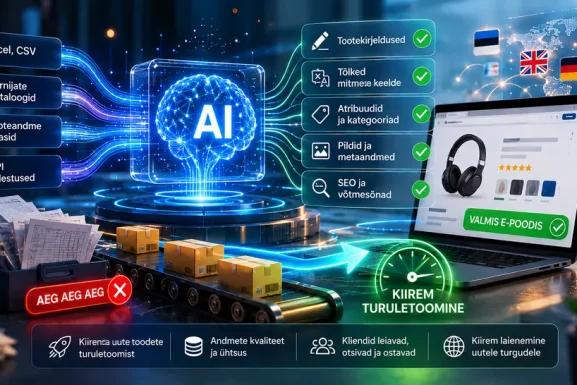
PIM can be integrated with various AI solutions to speed up the enrichment of product information. In this case, PIM would act as a product information orchestration and quality control environment, and the product information inputter would be the product information moderator. Lumav helps customers create a process that is just right for them in the automation of product information.
Didn’t find an answer to your question? Contact us and we will answer you personally.
Related services
Product information management is part of the wider business process automation family. See also: