E-business integrations — connect your online store with the necessary business systems
Your online store must communicate with various software, such as business software, warehouse system and marketing platforms. Without integrations, this means manual work, errors and lost sales. Lumav interfaces your online store with all important systems — we have done this with business software, production software, accounting programs, product information platforms (PIM), marketing platforms, external suppliers, etc.
In the self-service environments of the business client, the aggregation of important information for the client on its own e-platform gives your business a competitive advantage.
We are the only Erply Gold Partner in Estonia. We own the interfacing of different systems since the company’s first year, and the lead analyst has 7+ years of experience in developing complex manufacturing and financial software before that. No interface has been left undone, and we have been a partner for several companies in optimizing existing interfaces.
Our experience covers the creation of suitable interfaces for private customer online stores as well as self-service environments of business customers.
Why is system integration business critical?
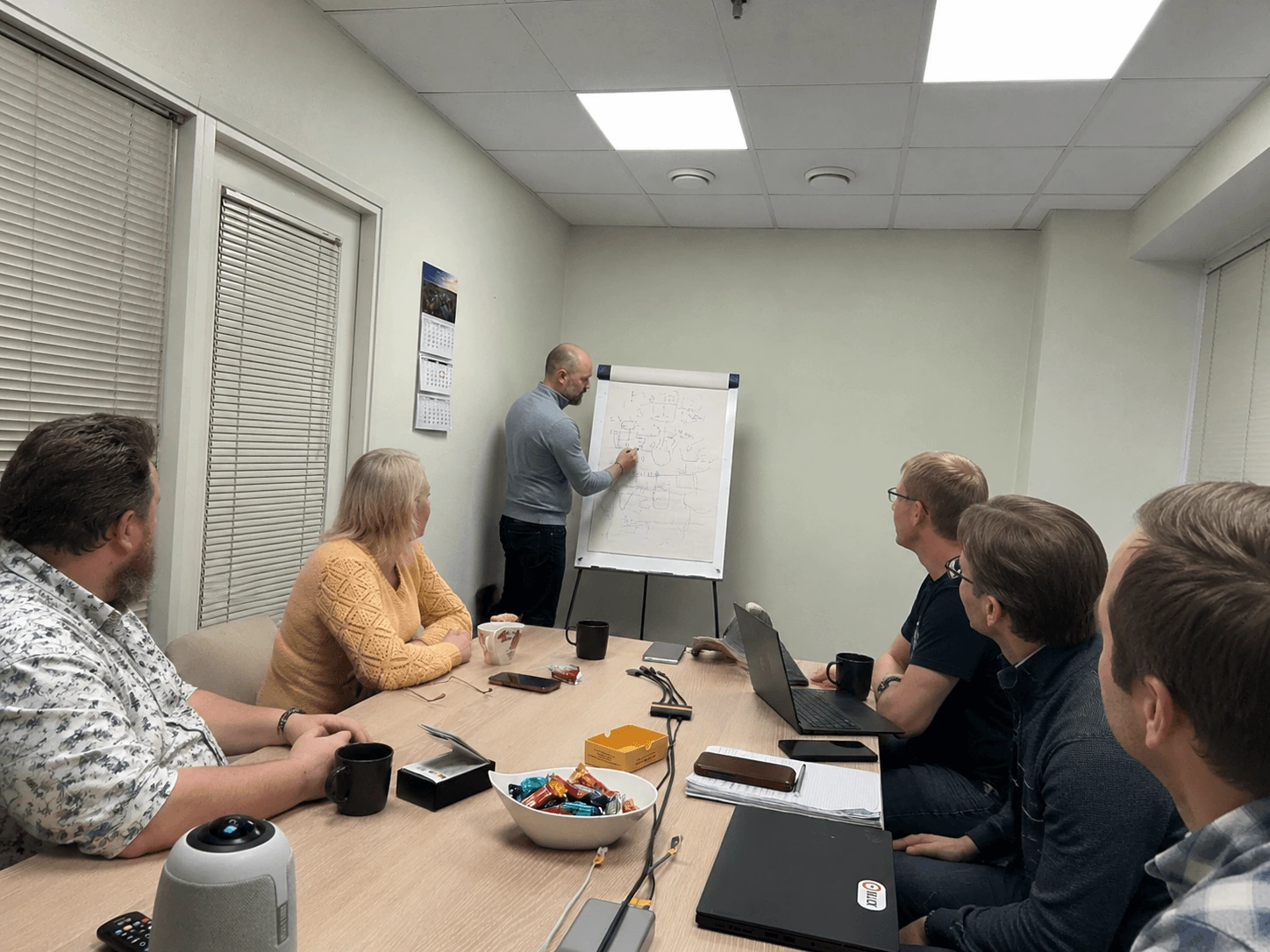
The first business problem solved by online store interfacing is inventory update between online store and retail to avoid double booking of products. The next step is to create an omnichannel experience by displaying the inventory of other retail stores in the online store so that the customer knows what to go to the physical store. As further steps, it is also possible to personalize the customer account according to the customer’s place of residence and create more complex order management systems.
Without automatic data exchange, you have to manually enter every inventory change, every price update, and every order into multiple systems. A bigger problem also arises in a situation where the systems are interfaced but incorrectly optimized. You have to assess which information is the most business-critical for the customer and which needs to be updated more often.
More business cases why interfacing would be needed:
- It takes time to update the campaign price lists
- Getting confirmed orders into the business software
- Interfacing product information — interfacing with product information management system (PIM) and external suppliers
- Input to the marketing software — reaching the marketing of the activities performed in the online store
- Analytics — moving and combining data between different customer bases (CDP).
- Price lists and assortment of business customers — the customer wants to see his own prices and special offers
- Subusers of business customers — if there are more orderers in the organization, i.e. subusers with different rights (B2B self-service)
- Asset management — customer asset management, based on which new products can be recommended
- Other external systems — displaying important information for the customer in the online store and combining it either for recommendations or for making purchase decisions
The larger your product range and the number of orders, the more critical automatic data exchange becomes. Automation of business processes is not a luxury — it is a prerequisite for your e-business to grow.
What systems does Lumav interface with?
During our experience, we have interfaced Magento online stores with very different systems. Here’s an overview.
Business software (ERP)
Lumav has experience in interfacing with the most popular business software:
- Erply
- SAP Business One
- Microsoft Dynamics NAV / Business Central
- Directo
- Standard Books
- Merit Active
- Boom
- Prodmaster
- Noom
- Epicor
- …etc.
If your company uses another system, get in touch — we’ve probably made a similar interface before.
Product Management Systems (PIM)
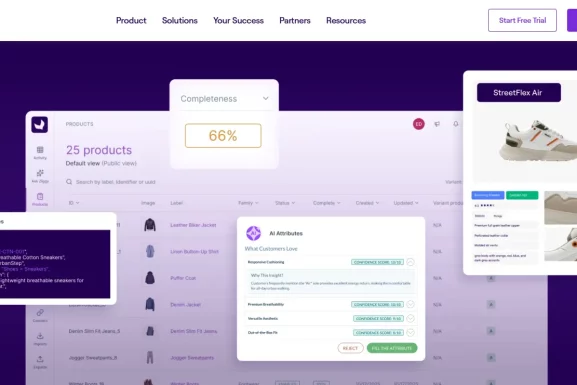
Companies with a large product range use a PIM system to centrally manage product information and distribute it to different sales channels.
- Akeneo
- InRiver
- Custom product management system
PIM integration ensures that product descriptions, parameters, images and translations are automatically transferred to the online store. Read more about product information management.
Marketing automation and CRM
The integration of marketing platforms with the online store enables automatic campaigns, personalized offers and customer behavior analysis.
- Mailchimp
- Smiley
- Custobar
- Keyboard
The integration allows, for example, to send automatic email messages about abandoned carts, recommend products based on purchase history, and segment the customer base based on purchase data.
How do the integrations work technically?
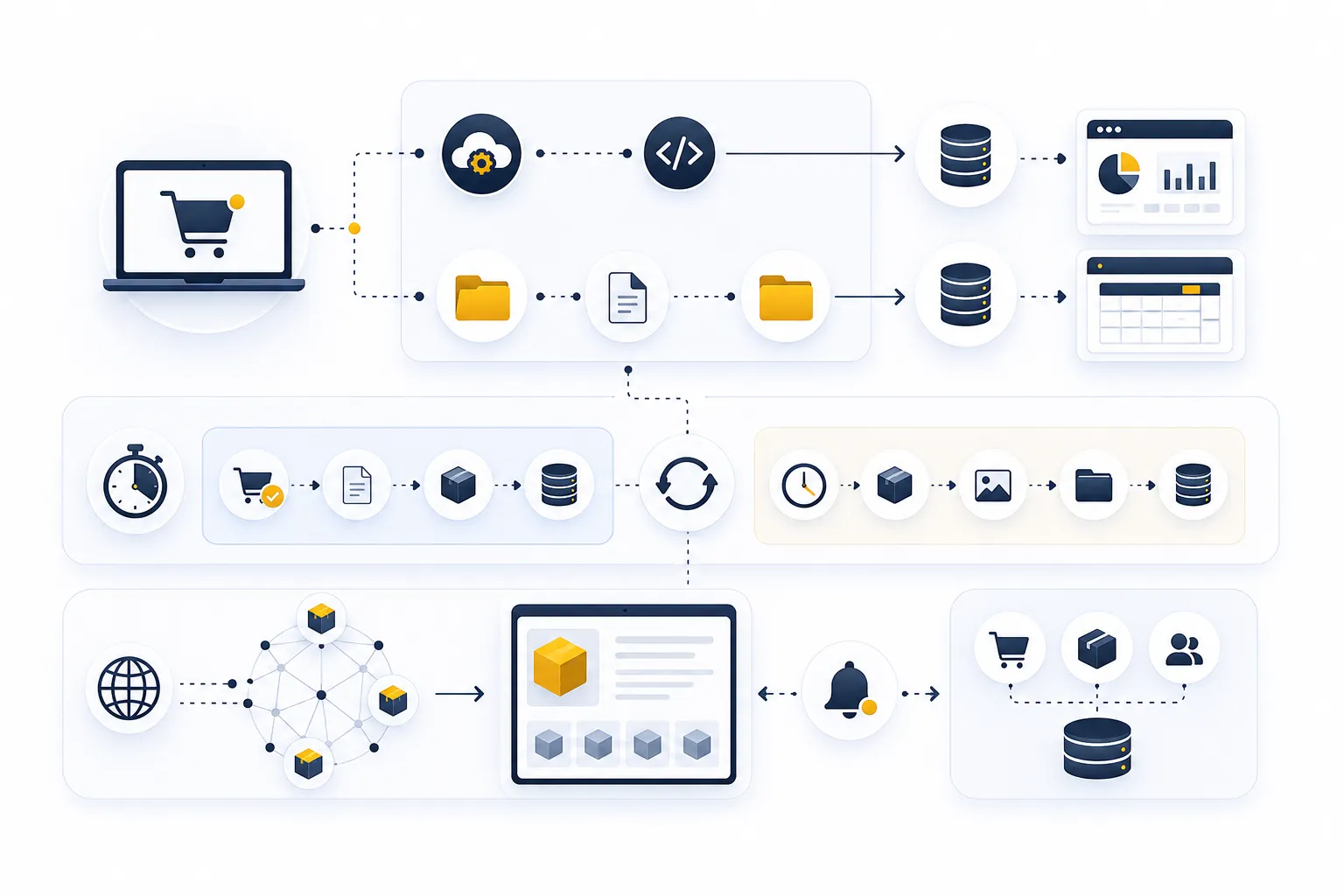
Can be interfaced through API or files. In the case of an API, a connection has been established where the active party retrieves information. In the case of files, access is given to the folder where the data is also updated at intervals if the file is updated.
It is possible to interface data in any format, as well as files, images, videos, etc.
Lumav has invested in a product information enrichment solution and external assortment interface, which allows the online store to grow into a department store (SYNC AI).
Two main approaches to data integration:
Real-time synchronization
Data moves as soon as something changes. For example: a customer places an order in an online store and the order immediately arrives in the economic software. Suitable for orders, inventories and prices where speed is important.
Scheduled sync
Data moves at fixed intervals — for example, every 15 minutes or every hour. Suitable for product information, images and categories where real-time updates are not critical.
Which approach to use depends on your business logic. Most integration projects use both — orders in real time, product information in timed cycles.
Webhooks also enable reverse notification — for example, the economic software sends a message to the online store when the inventory has changed. This reduces the load on the systems and ensures a faster response.
Charming — Erply Gold Partner
Lumav is the only Erply Gold Partner in Estonia. We are happy to work with all business software, but we can offer Erply customers a deeper level of collaboration in building applications.
What this means for you:
- We have interfaced Erply solutions with Magento online stores since 2014
- We know the Erply API and business logic — integration is faster and more reliable
- We develop products together (B2B solutions), create custom applications. It is possible to solve business problems on a broader level
- Erply has customers all over the world and serves many well-known brands such as Victorinox, Zappos, M&M etc.
If your company uses Erply, you can also get help from us in automating business processes and creating custom solutions. We develop applications and online stores that are two-way interfaced with Erply in real-time, and this allows us to create complete omnichannel solutions at a very affordable price.

Our experience in creating integrations
Lumav has more than ten years of experience in system interfacing. We started programming warehouse, production and accounting software in 2009. Since 2013, we have specialized in the Magento platform, and today we are an Adobe partner and certified Magento developers.
Why is experience important? Integration projects are technically complex, and their incomplete operation or even standstill can mean a sudden workload for the team on a daily basis. Each ERP system behaves differently, each business logic is unique, even for companies operating in the same field. We can share our best practices and guarantee that the solution we create is reliable.
- Experience in system interfacing since 2009
- Specializing in the Magento platform since 2013
- Adobe partner and certified Magento developers
- Best practices and reliable solutions in complex integration projects
Frequently asked questions
Why is it necessary to interface the online store with economic software?
Nowadays, online stores are no longer created without an interface. Without integration, you have to manually enter all data — inventory, prices, orders, customer data — into several systems. Integration automates data exchange and frees up your team’s time for meaningful work.
What data does the online store and the ERP system exchange?
The most common data types are inventories, prices and price lists, orders and invoices, customer data, product information and categories. In the case of B2B online stores, customer-specific prices, credit limits and contract terms also move.
What is the difference between real-time and scheduled sync?
Real-time synchronization delivers data as soon as it changes — suitable for inventory and orders. Timed synchronization moves data at specific intervals (e.g. every 15 min) — suitable for product information and images where a delay of a few minutes is not critical.
How long does the online store integration take?
The duration of the integration project depends on the complexity of the systems and the amount of data. A simple inventory synchronization can be completed in a couple of weeks. A full ERP integration with orders, prices and customer data usually takes 1-3 months, but it also depends on the availability of the ERP representative and whether they need to develop anything further.
Do online store integrations need maintenance?
Yes. Systems are updated — ERP gets a new version, the online store platform is updated, the API changes. Integrations need constant monitoring and adjustment if necessary. That’s why we also offer online store maintenance, which covers keeping the integrations working. Through maintenance, we remain available to customers who have ordered the interface from us, but other development from other developers. We are happy to cooperate with your online store developer.
Didn’t find an answer to your question? Contact us and we will answer you personally.
Start your integration project
Ask for a free consultation and we will map out which integration solution makes the most sense technically and commercially for your online store.